Located in the Province of Siena,Colle di Val d’Elsa is a pretty medieval town that is not far from the historic via Francigena and was, therefore, a pit-stop for travellers and pilgrims for centuries. Like many cities in Tuscany, it was once a centre of artistic and artisanal production but, unlike most of its neighbours, remains that way to this day. It continues to be the Italian capital of crystal and, as such, has been nicknamed the “Bohemia of Italy.” In fact, Colle di Val d’Elsa accounts for 95% of all Italian crystal glass production and 14% of the global production of crystal, which is an incredible feat.
Due to this scale and the economic importance of the craft in the town, it remains central to life for locals, with the first Sunday of each month playing host to a crystal market in town and open-air demonstrations of glass-making (from around 3pm) in the historical centre of the city on Via della Misericordia. In addition, there is also a rather special museum dedicated to the craft, the Museum of Crystal of Colle di Val d'Elsa, which puts these incredible objects on display. If you have found a holiday rental in Siena and are spending time exploring the province, set aside some time to get a little bit off the beaten tourist path and come enjoy the peace and beauty of this amazing town and its rich cultural history. You might even pick up a piece of crystal as a special and lovely souvenir of your time in this beautiful part of the world.
6
Aug
2019
2019
Posted in: Architectural Gems
Churches & Religious Buildings
Curiosities
Localities
Must See Attractions
Orcia Valley
Pretty Views
Siena
Tourist Attractions
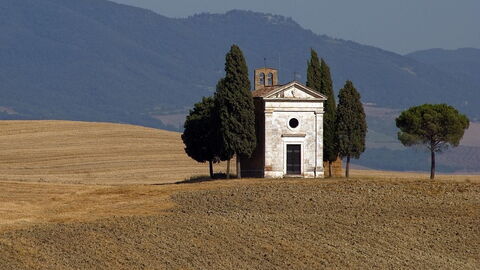
There are certain pictures of the lovely Tuscan countryside and landscape that get shared time and time again: the iconic winding roads and perfect rolling hills of the Val D’Orcia, Cypress Avenue in Bolgheri, and walled towns like Siena, as seen from a distance and with lush green surroundings. Amongst these “generic” images of the evocative Tuscan countryside, you are likely to spot one particular little chapel popping up time and time again, the Chapel of the Madonna di Vitaleta, or La Cappella della Madonna Vitaleta.
Located in the province of Siena, next to the village of Vitaleta, on the road between San Quirico d’Orcia and Pienza, this pretty little house of worship is one of the most photographed churches in Tuscany and is a picture-perfect gem. Framed by cypress trees either side of the single bay, white stone-clad gem, and surrounded by rolling green hills, it looks almost too idyllic for real life. But real it is, and it is also free to visit whenever you please. Just find a holiday rental in Siena and come see it for yourself.
Located in the province of Siena, next to the village of Vitaleta, on the road between San Quirico d’Orcia and Pienza, this pretty little house of worship is one of the most photographed churches in Tuscany and is a picture-perfect gem. Framed by cypress trees either side of the single bay, white stone-clad gem, and surrounded by rolling green hills, it looks almost too idyllic for real life. But real it is, and it is also free to visit whenever you please. Just find a holiday rental in Siena and come see it for yourself.
Located not far from the town of Castiglione della Pescaia, in the heart of the Maremma, there is a particularly beautiful winery called Le Mortelle. Vineyards and wineries are dotted all over the area but this particular example is especially charming and set within the most extraordinary surroundings. It is an excellent spot to go and sample and purchase some delicious Tuscan wines and learn more about wine and wine-making so, if you have found a vacation rental in the Grosetto-Maremma area and are looking to indulge in some local vintages, make sure to head to Le Mortelle.
Named after the “mortella”, or wild myrtle, that grows all over the surrounding landscape of the area, the winery is on an estate that was once part of an even larger estate called La Badiola that is recorded on the maps of Grand Duke Leopoldo II of Tuscany in the 19th century. La Badiola was a pilot version of a model of an estate that the Hapsburg Lorraine rulers of the Grand Duchy hoped to establish, in which the marshy and malaria-ridden lands of this coastal part of Tuscany would be drained and repurposed for raising cattle. This land, however, has been since reappropriated once more and the 270 hectares of the estate have been planted with 170 hectares of vineyards of Cabernet Sauvignon and Cabernet Franc, as well as more recently planted vineyards of white grape varieties such as Vermentino, Ansonica, Viognier, and a small area of Carménère by the Antinori family.
Named after the “mortella”, or wild myrtle, that grows all over the surrounding landscape of the area, the winery is on an estate that was once part of an even larger estate called La Badiola that is recorded on the maps of Grand Duke Leopoldo II of Tuscany in the 19th century. La Badiola was a pilot version of a model of an estate that the Hapsburg Lorraine rulers of the Grand Duchy hoped to establish, in which the marshy and malaria-ridden lands of this coastal part of Tuscany would be drained and repurposed for raising cattle. This land, however, has been since reappropriated once more and the 270 hectares of the estate have been planted with 170 hectares of vineyards of Cabernet Sauvignon and Cabernet Franc, as well as more recently planted vineyards of white grape varieties such as Vermentino, Ansonica, Viognier, and a small area of Carménère by the Antinori family.
4
Jul
2019
2019
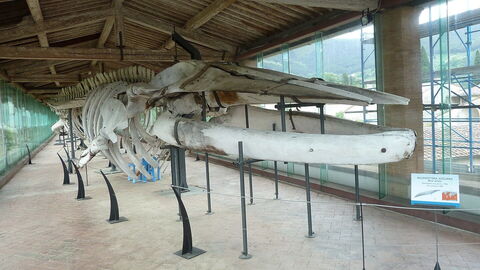
The University of Pisa is one of the oldest universities in the world and it is also home to a Natural History Museum that is also one of the oldest museums in the world. It has a surprisingly impressive and rich collection that could compete with any natural history museum in the world. If you have found a vacation rental in Pisa and you are looking for somewhere to spend a couple of hours out of the sun and learning more about the natural world, this is a fun and educational spot that is perfect to do just that!
Located in the Pisa Charterhouse (the Carthusian Monastery of Calci), 10km from the city of Pisa in the comune of Calci, the Natural History Museum of the University of Pisa (Museo Di Storia Naturale dell'Università di Pisa) was founded in 1596 by Grand Duke Ferdinand I of Tuscany. Originally composed of specimens sent from the Florentine palaces of the Medici and the Uffizi, in particular, it was somewhat fashioned on the German idea of a “wonderland”, meaning that it gathered together a variety of natural curiosities and oddities. This selection of minerals, zoo animals, skeletons, fossils, and more eventually expanded into a proper institution in its own right and became an early example of a natural history museum, which boasted a rich and impressive collection.
Located in the Pisa Charterhouse (the Carthusian Monastery of Calci), 10km from the city of Pisa in the comune of Calci, the Natural History Museum of the University of Pisa (Museo Di Storia Naturale dell'Università di Pisa) was founded in 1596 by Grand Duke Ferdinand I of Tuscany. Originally composed of specimens sent from the Florentine palaces of the Medici and the Uffizi, in particular, it was somewhat fashioned on the German idea of a “wonderland”, meaning that it gathered together a variety of natural curiosities and oddities. This selection of minerals, zoo animals, skeletons, fossils, and more eventually expanded into a proper institution in its own right and became an early example of a natural history museum, which boasted a rich and impressive collection.
24
Jun
2019
2019
Posted in: Beaches
Curiosities
Localities
Must See Attractions
Top 10 Lists
Tourist Attractions
Tuscan Coast
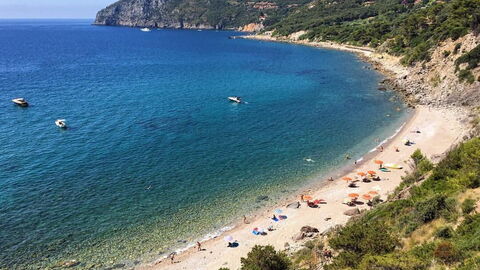
The Tuscan Coast is less well-regarded and famous internationally than its inland counterparts, from famous cities like Pisa and Florence to its iconic rolling green hills and lines of cypresses. Yet, despite this, it is an excellent place to holiday, offering unbridled opportunity to explore. With a holiday rental on the Tuscan Coast, you can spend time discovering the different islands (each with their own unique characters), the charming and sleepy little seaside villages, the bustling promenades and bright lights of the larger resort towns, the natural wonders of the Orbetello Lagoon and the Maremma, and the absolutely picture-perfect beaches. The area in and around Monte Argentario, in particular, boasts a lot of exceptional beaches. Just find a vacation rental in Monte Argentario and come discover her many incredible beaches for yourself!
Located in the Tyrrhenian Sea, nestled between Giglio Island and the mainland Tuscan province of Grosseto, Monte Argentario was once an independent island but, around 4,000 years ago, two narrow strips of land called Isthmuses formed with water on either side and connected the north eastern and eastern side of Monte Argentario Island to the mainland, making it into the peninsula and comune that exists today.
Located in the Tyrrhenian Sea, nestled between Giglio Island and the mainland Tuscan province of Grosseto, Monte Argentario was once an independent island but, around 4,000 years ago, two narrow strips of land called Isthmuses formed with water on either side and connected the north eastern and eastern side of Monte Argentario Island to the mainland, making it into the peninsula and comune that exists today.