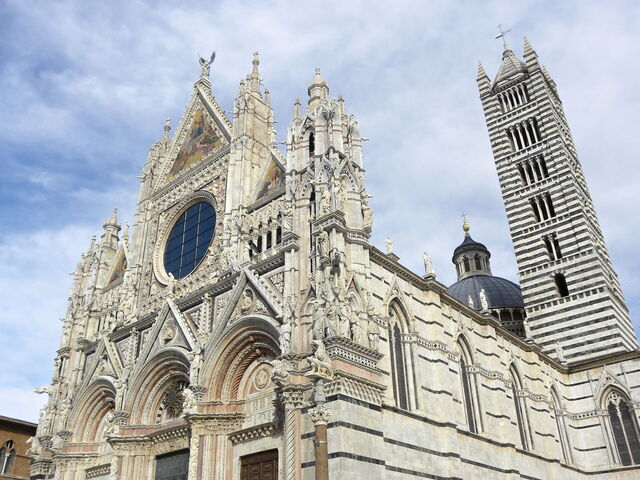
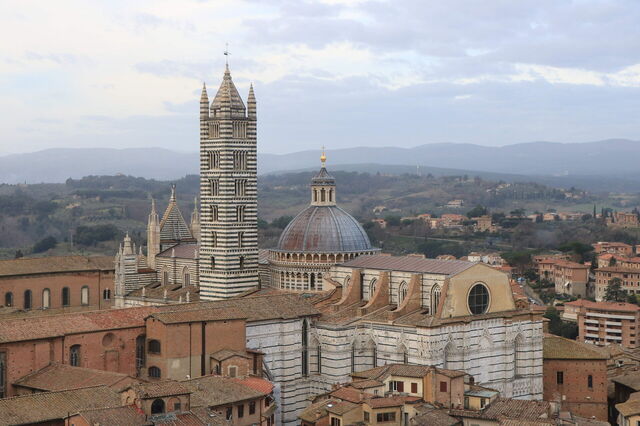
The benefit of exploring churches throughout the region if you have found a Tuscany villa, no matter your religious affiliation or lack thereof, is that an incredible number of them house spectacular artworks by some of the most famous artists from the region throughout history. This is true of both tiny little churches that might not seem like anything from the outside and, more often of course, of the various town cathedrals throughout Tuscany. If you find a villa with pool in Siena, for example, and are spending time discovering all that beautiful and historic city has to offer, then you will likely see the ornate Gothic façade, rising tower, and central dome of the Duomo (or cathedral) from various points around the city. This might give you pause to consider the building and we highly recommend going one step further and actually planning a visit to this gem while staying in your villa in Siena. With a richly ornamented exterior and a stunning interior that boasts artworks by the likes of Pisano, Donatello, and Michelangelo, it is a wonderful reflection of the artistic heritage of Tuscany and is full of gorgeous objects and pieces of art to admire...
Located right in the heart of the historic core of this medieval city, the cathedral is built on a site that was previously home to many other structures, though some of the exact details of these have been lost to the mists of time. We do know for certain that there was a bishop's palace on the site in the 9th century that had a church attached and that the cathedral masons’ guild was engaged to construct a new cathedral for the city on the spot in 1196. Work began with the transept and a larger body was planned but never actually executed. Records show that by 1215 there were already masses being held in the cathedral, or however much of the building had been completed by that point, on a daily basis. Accounts of the arrival of black and white marble in 1226 indicate that this was likely when the work on the façade and the bell tower began and we know that the vaults and transept were completed between 1259 and 1260. The planned additions to the church that were never completed began in 1339 but construction had been complicated by communication errors between the various parties involved and then was ultimately completely put to a halt by the Black Death in 1348 and never picked up again. Some of this halted extension now houses a parking lot and the cathedral’s museum.
The elements that were completed, however, and that one can admire today include the stunning façade, which was built in two phases and combines elements of the French Gothic, Tuscan Romanesque, and Classical styles. Executed in beautiful polychrome marble, work on the lower part was begun around 1284 and was overseen by Giovanni Pisano and is completed in the Tuscan Romanesque style. Here we see richly sculpted columns, decorative elements, and various figures and scenes from biblical stories as well as allegorical figures. After Pisano fell out with the organisers over creative differences, he left in 1296 and work was continued by Camaino di Crescentino with some changes including the adding of a larger rose window based on designs by Duccio di Buoninsegna to the west façade. The work here ended suddenly in 1317 and efforts were focused entirely on the east façade. It is thought that work on the upper façade was ultimately finished sometime between 1360 and 1370 and Pisano’s plans, once again, still formed the basis of the work, with Giovanni di Cecco overseeing it and adding more elaborate ornamentation inspired by the French Gothic. This makes the visual language between the upper and lower parts noticeably different.
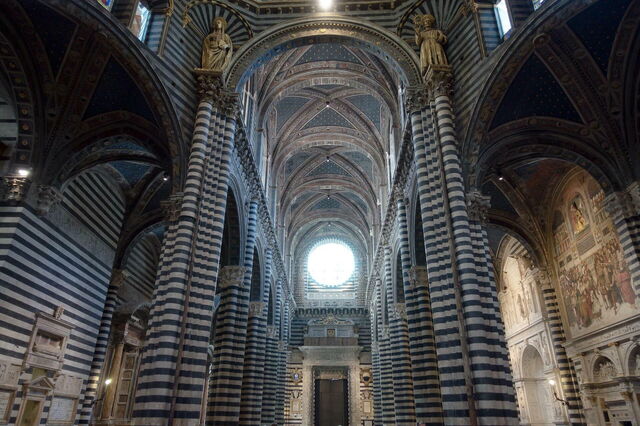
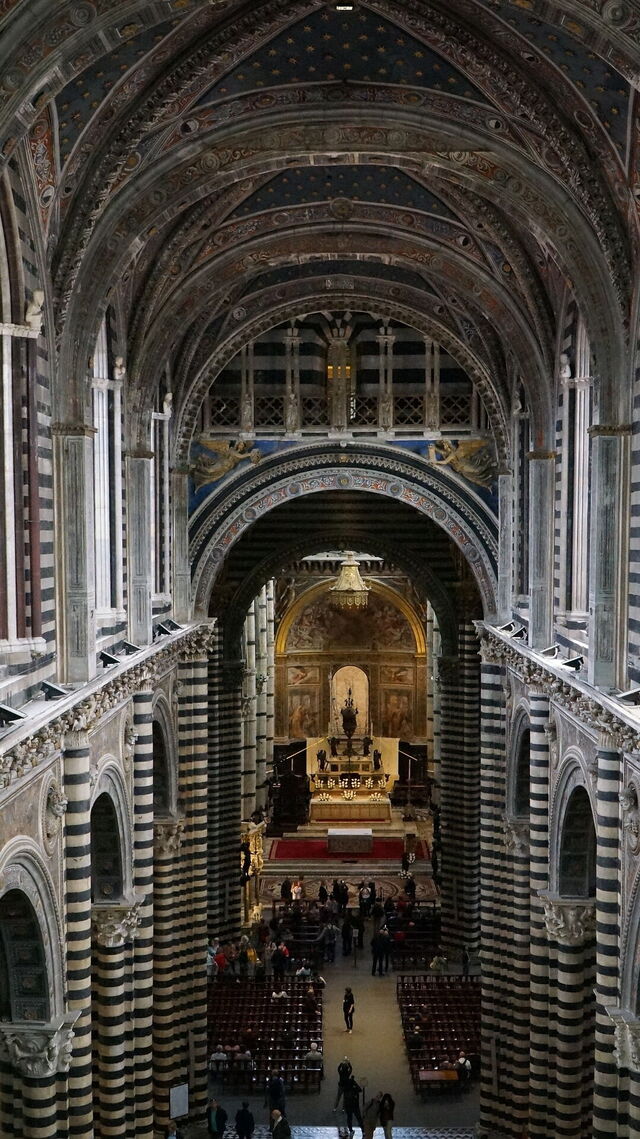
Inside, the polychromatic black and white marble is continued in stripes across the walls and columns, a striking and distinctive feature and the colours of the coat of arms of the city. Rich ornamentation also continues indoors with the capitals of the columns featuring sculpted allegorical and animal figures, 172 plaster busts of popes in the moulding around the nave and presbytery, a vaulted roof painted blue with golden stars, the ribs painted in elaborate motifs, stained-glass in the choir made according to designs by Duccio, Bernini's gilded lantern atop the dome, images and statues of 42 patriarchs and prophets by Guidoccio Cozzarelli and Benvenuto di Giovanni along the colonnade in the drum, stucco statues in the spandrels beneath the dome by Ventura di Giuliano and Bastiano di Francesco, and an elaborate mosaic floor with 56 panels of images from the Old Testament and of allegories and virtues by a variety of different artists, to name only some of the extraordinary elements that make up this treasure box of a building. In addition to all of this, there are many very valuable works of art that include sculpted works by Donatello, Bernini, Michelangelo as well as lots of incredible painted works. Much of the collection now lives in the protected environment of the adjoining cathedral museum (though some pieces have gone to the Uffizi and other museums elsewhere) and can be seen in the original there while excellent copies remain in their original spots inside and outside the cathedral. The whole building is truly like one astounding museum and is utterly spectacular and breathtaking to behold.
Those with any interest at all in art or history or exceptional sights who are planning on finding a luxury villa in Siena should, therefore, absolutely make a point to pay a visit to this showstopping cathedral and take in one of the most fascinating cultural attractions in all of Tuscany.