In our final post in this series, here are two more architectural gems that one might make time for when exploring the incredibly rich culture and artistic heritage of the region. Of course, there are many other wonderful examples of great architectural feats all around Tuscany but these are some of our personal favourites and are, largely, somewhat less well-known than the most famous works that every tourist seems to flock to magnetically. Fnd a luxury villa in Tuscany and explore these delightful structures for yourself.
Florence, of course, is packed to the gills with artistic and architectural gems. However, one of the most striking and theatrical is the Laurentian Library. Home to the most important and prestigious collection of antique books in all of Italy and one of the greatest scholarly legacies left behind the Medici family that is still in existence, it was born of the passion of Cosimo the Elder.
As he was an avid collector, it became necessary in 1523 for Pope Clement VII (Giulio de' Medici) to commission a new library to house the massive collection.
Florence, of course, is packed to the gills with artistic and architectural gems. However, one of the most striking and theatrical is the Laurentian Library. Home to the most important and prestigious collection of antique books in all of Italy and one of the greatest scholarly legacies left behind the Medici family that is still in existence, it was born of the passion of Cosimo the Elder.
As he was an avid collector, it became necessary in 1523 for Pope Clement VII (Giulio de' Medici) to commission a new library to house the massive collection.
The architect hired for the job was Michelangelo, who planned it, worked on it in person for ten years and then monitored its progression after his departure to Rome in 1534. It is one of the most unified Mannerist buildings, with its decor having being executed at the same time as its construction. The reading-room is elegant and lovely but it is the lobby or “ricetto”, that garners the most attention and awe.
Built in characteristic Florentine two-one combination of grey sand-stone elements on white plaster, it makes a bold statement. It is expressed in dynamic tabernacle niches, paired columns and frames and, at the centre of it all, the waterfall-like fantastical staircase that was built under Ammannati in 1559, after a model by Michelangelo.
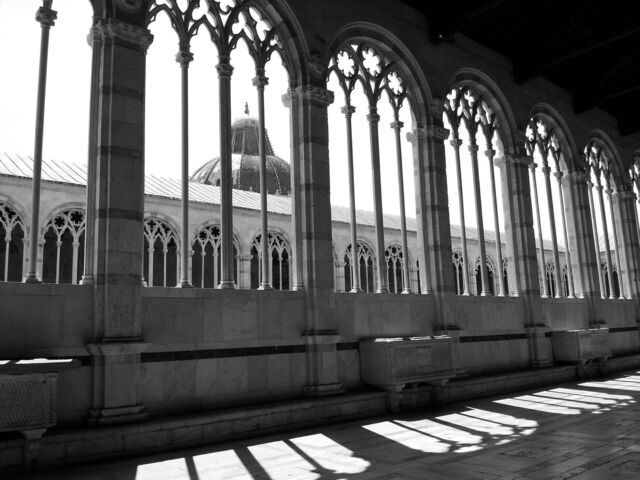
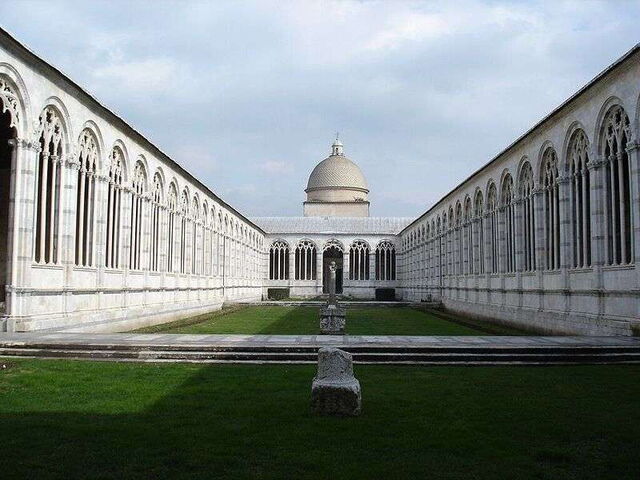
Another Pisan example, meanwhile, is the Camposanto (literally meaning “holy field”), or Monumental Cemetery.
Built in characteristic Florentine two-one combination of grey sand-stone elements on white plaster, it makes a bold statement. It is expressed in dynamic tabernacle niches, paired columns and frames and, at the centre of it all, the waterfall-like fantastical staircase that was built under Ammannati in 1559, after a model by Michelangelo.
Another Pisan example, meanwhile, is the Camposanto (literally meaning “holy field”), or Monumental Cemetery.
Constructed in the 13th century, using sacred dirt brought back from Golgotha during the Crusade, it was later decorated with extensive frescoes and was the burial place of the Pisan upper classes for centuries. The holy earth was brought to Pisa in the 12th century and, in 1278, Giovanni di Simone, the same architect who designed the iconic Leaning Tower, was called upon to create a structure to enclose it.
In the 14th and 15th centuries, the walls were embellished with frescoes by Taddeo Gaddi, Spinello Aretino, Benozzo Gozzoli, Andrea Bonaiuti, Antonio Veneziano, and Piero di Puccio. Almost completely destroyed during World War II, they have since been restored and moved to the Museo delle Sinopie in Pisa. The funerary monuments and ancient Roman sculptures and sarcophagi that were added are also a highlight. However, the striking building itself is the star of the show and would need no other embellishment to shine.
On your next trip to Tuscany, be sure to make time for these incredible architectural gems!
In the 14th and 15th centuries, the walls were embellished with frescoes by Taddeo Gaddi, Spinello Aretino, Benozzo Gozzoli, Andrea Bonaiuti, Antonio Veneziano, and Piero di Puccio. Almost completely destroyed during World War II, they have since been restored and moved to the Museo delle Sinopie in Pisa. The funerary monuments and ancient Roman sculptures and sarcophagi that were added are also a highlight. However, the striking building itself is the star of the show and would need no other embellishment to shine.
On your next trip to Tuscany, be sure to make time for these incredible architectural gems!
Photo credits
picture 2: Kian Wright / CC BY-SA 3.0
picture 2: Kian Wright / CC BY-SA 3.0