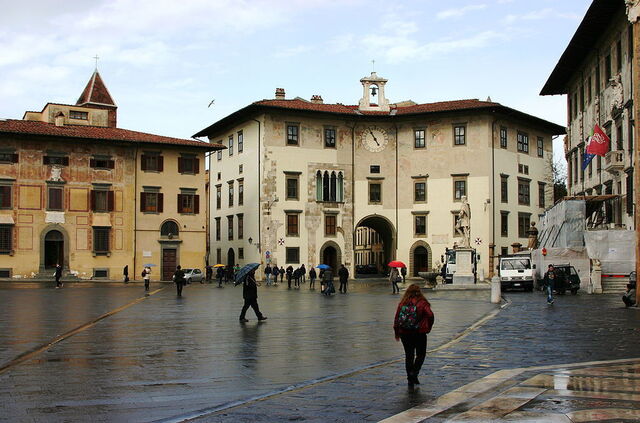
The Knight's Square, or Piazza dei Cavalieri, in Pisa is a town square and a landmark that holds particular historical importance. It is thought to have Roman origins, was a political centre during the Middle Ages, used as the headquarters of the Order of the Knights, and was the site of Medici displays of power. After 1140 many churches and buildings belonging to different municipalities were built around the square and it is full of other secular buildings, particularly those from 16th century rebuilding by Vasari, that are rich in culture and history as well. If you want to sit out in a sunny town square and soak up Italian culture and history and enjoy the lifestyle, find a villa with pool in Pisa.
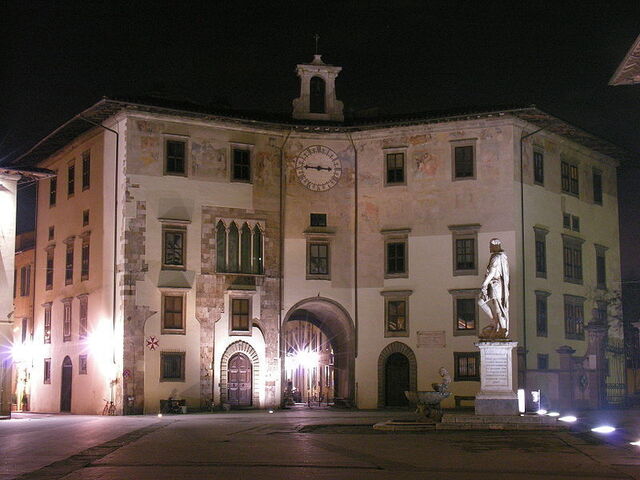
Located in the University Quarter, the Knight's Square is positioned at the edge of the medieval city centre, just a short walk from the Piazza dei Miracoli.
Known as the Square of the Seven Roads during the time of the Pisan Republic, it is thought to have been the site of the Roman Forum of Pisa.
It became the centre of politics of the entire Pisan Republic when Cosimo I de' Medici made it into the seat of the The Knights of Saint Stephen in order to eradicate any trace of the city's past struggles for independence.
Known as the Square of the Seven Roads during the time of the Pisan Republic, it is thought to have been the site of the Roman Forum of Pisa.
It became the centre of politics of the entire Pisan Republic when Cosimo I de' Medici made it into the seat of the The Knights of Saint Stephen in order to eradicate any trace of the city's past struggles for independence.
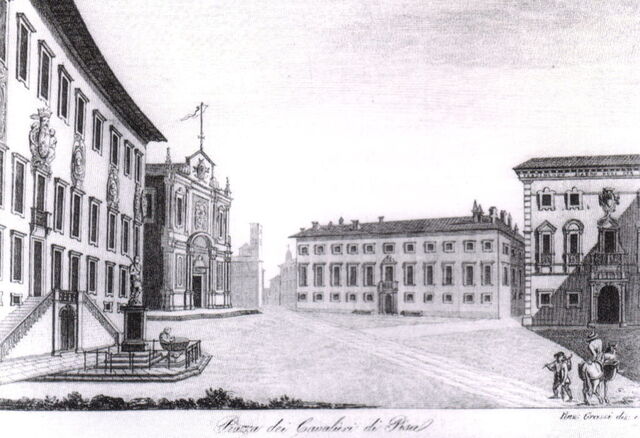
From 1556 to 1569, the buildings were reconstructed with a Renaissance flair. Giorgio Vasari was the lead architect for the project and designed, with the help of other architects, the Church of the Knights of the Holy and Military Order of St. Stephen and Palazzo della Carovana. The piazza was lavishly remodelled creating a landmark example of Renaissance architecture and spacious town planning. The church was built over the foundation of a previous church to Saint Sebastian. The palace was originally the old republic's Hall of City Elders and eventually became the base for the Knights of St. Stephen.
Redesigned with a more contemporary look by Vasari for this purpose, his new façade is striking and eye catching. It is covered with sgraffiti, with layers of colourful plaster covering the whole surface and accented by busts of the Grand dukes of Tuscany. In front of the building stands a statue of Cosimo, which is also by Vasari and which also features sgraffiti.
One of the most striking buildings in the piazza is the Palazzo dell'Orologio. Transformed into the present structure by uniting by bridge the two crumbling towers of the Count della Gherardeschi, it became the infirmary of the knights. Not only is it a distinctive building, but it is also independently famous due to being mentioned by Dante in his “Inferno”. In the book, the story of Ugolino, a suspected traitor is told. It is said to have been in one of those towers that he was left to die of starvation, along with the other males of his family whose corpses he eventually fed upon.
If you visit Pisa and want a real sense of the city's history then the Knight's Square should be the first place on your itinerary! You can even take several different tours.
Redesigned with a more contemporary look by Vasari for this purpose, his new façade is striking and eye catching. It is covered with sgraffiti, with layers of colourful plaster covering the whole surface and accented by busts of the Grand dukes of Tuscany. In front of the building stands a statue of Cosimo, which is also by Vasari and which also features sgraffiti.
One of the most striking buildings in the piazza is the Palazzo dell'Orologio. Transformed into the present structure by uniting by bridge the two crumbling towers of the Count della Gherardeschi, it became the infirmary of the knights. Not only is it a distinctive building, but it is also independently famous due to being mentioned by Dante in his “Inferno”. In the book, the story of Ugolino, a suspected traitor is told. It is said to have been in one of those towers that he was left to die of starvation, along with the other males of his family whose corpses he eventually fed upon.
If you visit Pisa and want a real sense of the city's history then the Knight's Square should be the first place on your itinerary! You can even take several different tours.
Photo credits
picture 1: José Luiz Bernardes Ribeiro / CC BY-SA 3.0;
picture 2: Andrea Nardi / CC BY-SA 3.0
picture 1: José Luiz Bernardes Ribeiro / CC BY-SA 3.0;
picture 2: Andrea Nardi / CC BY-SA 3.0