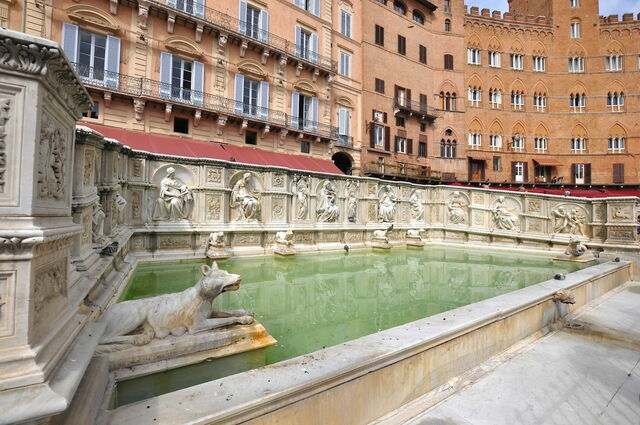
If Rome has the Trevi Fountain, then Siena has the Fonte Gaia. While not nearly so famous as the former, the Fonte Gaia is a serious looker and impressive artistic gem that is covered in stunning sculptural works. If you have found a luxury villa in Siena and are spending time in this beautiful city, then be sure to set aside some time to come and admire this incredible fountain and its wonderful decorative scheme for yourself. And, maybe, as with the Trevi Fountain, bring along a coin to toss in and make a wish.
The Fonte Gaia is located in Siena's famous Piazza del Campo, where the city's iconic Palio horse races are held each summer. The main square of the town, it is a massive, charming space filled with eateries and shops and is one of the places that locals, visitors, and tourists all end up floating to at some point. When you make it there, you will likely see a crowd gathered around the Fonte Gaia, something which is a permanent fixture of the square but much less intense and large than the crowds that constantly gather around the Trevi Fountain. You probably won't have to wait around for quite as long to get your chance for a look, a wish, and a photo!
The Fonte Gaia is located in Siena's famous Piazza del Campo, where the city's iconic Palio horse races are held each summer. The main square of the town, it is a massive, charming space filled with eateries and shops and is one of the places that locals, visitors, and tourists all end up floating to at some point. When you make it there, you will likely see a crowd gathered around the Fonte Gaia, something which is a permanent fixture of the square but much less intense and large than the crowds that constantly gather around the Trevi Fountain. You probably won't have to wait around for quite as long to get your chance for a look, a wish, and a photo!
Built in 1419 as a place where the townspeople of Siena could get drinking water and satisfy other practical needs, the water is now no longer potable but the fountain remains as a meeting point, important tourist attraction, and incredible artistic gem. Made of a white marble pool backed by marble sculptural details (now replaced by copies of the originals, which are housed in the nearby Palazzo Pubblico to keep them safe today), the fountain is one of the few medieval fountains in Siena to be supplied with water from ancient aqueducts and canals in the surrounding Tuscan hills and is also the highest fountain in Italy at 321 meters above sea level.
Nicknamed, “the queen of Sienese fountains,” Fonte Gaia was designed by Siena's most acclaimed sculptor, Jacopo della Quercia, to replace an older fountain that featured a statue of the goddess Venus. After the Black Death and the loss of the lives of 80,000 Senese residents, this pagan statue was blamed and it was decided to replace it with a new fountain that would be dedicated, instead, to the Virgin Mary. When it was completed, the people of Siena were joyous in their celebrations and, as a result, the fountain was called the Fonte Gaia, or Fountain of Joy.
While the fountain is dedicated to the Virgin, who is represented in the image of the Madonna and Child at the centre of the fountain, there are also lots of other different biblical scenes and images that were inspired by the traditional designs of Medieval public fountains in Siena. Represented in the decorative scheme of this sculptural gem there are scenes depicting the creation of Adam and Eve and the flight from the Garden of Eden, images of two angels, and a depiction of the cardinal virtues, among other details. By the mid-19th century, these works were already in a bad condition from being exposed to the elements and Tito Sarrocchi was commissioned to sculpt a copy of the fountain in 1858 while the originals were moved into the Loggia of the Palazzo Pubblico.
A large-scale project of restoration of the original pieces took place in the early 1990s under the patronage of Florence’s Opificio delle Pietre Dure in collaboration with the town council of Siena and the Sovrintendenze dei Beni Architettonici e Ambientali e Artistici e Storici di Siena and it was entirely reassembled within a protective structure inside the palazzo.
Today, the fountain is still a central figure within the city of Siena, if not within the daily routines and lives of the people of Siena any longer. For those who have found a luxury villa in Siena or a luxury villa in Tuscany and are exploring the city, it is a must-see so that you can toss in a coin and make a wish to come back and have yet another magical holiday in beautiful Tuscany.
Nicknamed, “the queen of Sienese fountains,” Fonte Gaia was designed by Siena's most acclaimed sculptor, Jacopo della Quercia, to replace an older fountain that featured a statue of the goddess Venus. After the Black Death and the loss of the lives of 80,000 Senese residents, this pagan statue was blamed and it was decided to replace it with a new fountain that would be dedicated, instead, to the Virgin Mary. When it was completed, the people of Siena were joyous in their celebrations and, as a result, the fountain was called the Fonte Gaia, or Fountain of Joy.
While the fountain is dedicated to the Virgin, who is represented in the image of the Madonna and Child at the centre of the fountain, there are also lots of other different biblical scenes and images that were inspired by the traditional designs of Medieval public fountains in Siena. Represented in the decorative scheme of this sculptural gem there are scenes depicting the creation of Adam and Eve and the flight from the Garden of Eden, images of two angels, and a depiction of the cardinal virtues, among other details. By the mid-19th century, these works were already in a bad condition from being exposed to the elements and Tito Sarrocchi was commissioned to sculpt a copy of the fountain in 1858 while the originals were moved into the Loggia of the Palazzo Pubblico.
A large-scale project of restoration of the original pieces took place in the early 1990s under the patronage of Florence’s Opificio delle Pietre Dure in collaboration with the town council of Siena and the Sovrintendenze dei Beni Architettonici e Ambientali e Artistici e Storici di Siena and it was entirely reassembled within a protective structure inside the palazzo.
Today, the fountain is still a central figure within the city of Siena, if not within the daily routines and lives of the people of Siena any longer. For those who have found a luxury villa in Siena or a luxury villa in Tuscany and are exploring the city, it is a must-see so that you can toss in a coin and make a wish to come back and have yet another magical holiday in beautiful Tuscany.
Photo credit: Herbert Frank / CC BY 2.0