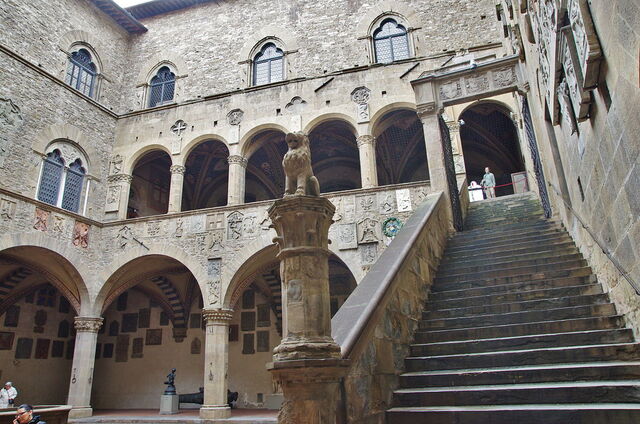
The Uffizi, the Accademia and the Duomo are probably the biggest artistic centers that most people head for right away upon finding a luxury villa in Florence. However, the Bargello is one of the best and most important art museums in Florence and should not be missed! Dating back to 1255, it was originally the headquarters of the Capitano del Popolo and later of the Podestà. In the sixteenth century, it became the residence of the Bargello (head of the police) and was used as prison during the whole 18th century. The building became a National Museum as of the mid-19th century and today it is an excellent sculpture museum, especially for early works by great masters of the Renaissance such as Donatello and Michelangelo.
1. Donatello's David
Donatello's name is one of the most enduringly famous of all Italian Renaissance artists.
1. Donatello's David
Donatello's name is one of the most enduringly famous of all Italian Renaissance artists.
An Early Renaissance sculptor and one of the representative artists of Florence, he was born in the city around 1386 and worked prolifically there his entire life, bar a period in which he worked in Padua. He trained under a local goldsmith and then, from 1403, he apprenticed with famous Florence metalsmith and sculptor Lorenzo Ghiberti. Shortly thereafter he became friends with another famous figure, Brunelleschi, and the pair travelled to Rome to study classical art. Upon returning, Donatello produced a marble figure of David. The influence of his time with Brunelleschi is visible in the long and graceful Gothic lines of the figure but his knowledge of classical works would become more and more apparent as time went on.
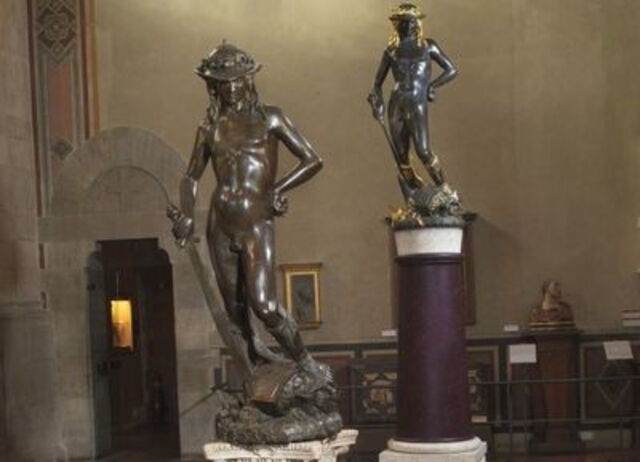
In 1430, he produced another David – this David – this time in bronze and very different from the earlier iteration. It is probably his most famous work and is notable for being free-standing without an architectural surroundings to support it and for its great beauty and drama that captured hearts at the time.
In 1430, he produced another David – this David – this time in bronze and very different from the earlier iteration. It is probably his most famous work and is notable for being free-standing without an architectural surroundings to support it and for its great beauty and drama that captured hearts at the time.
However, it was also divisive at the time, as his pose is often considered unsettling and perhaps overly sexualised. Debates still surround as to whether or not the sculpture is some sort of statement on Donatello's sexuality or homosocial values of Florence at the time. Whatever the implications of David's pose, Donatello still produced a male nude unlike most of what was being produced at the time and this famous work is still a highlight of the Bargello's collection.
2. Michelangelo's Bacchus
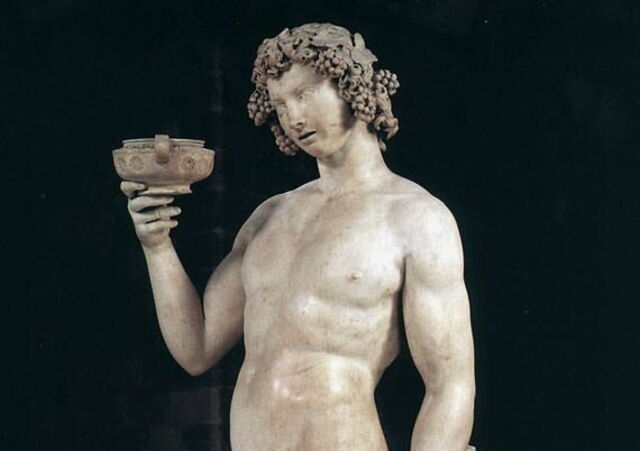
Michelangelo is one of the most famous artists in the western world, a fifteenth century Florentine sculptor, painter, poet, architect and engineer, he was prodigiously talented and the true definition of a Renaissance man. The Bargello also happens to be home to some of Michelangelo's early works, including Bacchus (1496–1497), a somewhat over life-size marble sculpture that depicts Bacchus, the Greek god of wine. Standing in a reeling pose suggestive of drunkenness, the work was commissioned by Raffaele Riario, a high-ranking Cardinal. However, it was rejected by him and was bought by Jacopo Galli, Riario’s banker and Michelangelo's pal. Along with the Pietà the Bacchus is one of only two surviving sculptures from the artist's first period in Rome and is, therefore, even more fascinating.
These are just two of the many must-see works in the Bargello, so be sure to read on to the next post in this series for even more sculptures to take note of for your trip.
2. Michelangelo's Bacchus
Michelangelo is one of the most famous artists in the western world, a fifteenth century Florentine sculptor, painter, poet, architect and engineer, he was prodigiously talented and the true definition of a Renaissance man. The Bargello also happens to be home to some of Michelangelo's early works, including Bacchus (1496–1497), a somewhat over life-size marble sculpture that depicts Bacchus, the Greek god of wine. Standing in a reeling pose suggestive of drunkenness, the work was commissioned by Raffaele Riario, a high-ranking Cardinal. However, it was rejected by him and was bought by Jacopo Galli, Riario’s banker and Michelangelo's pal. Along with the Pietà the Bacchus is one of only two surviving sculptures from the artist's first period in Rome and is, therefore, even more fascinating.
These are just two of the many must-see works in the Bargello, so be sure to read on to the next post in this series for even more sculptures to take note of for your trip.
Photo credits
picture 1: Polisemico / CC BY-SA 3.0;
picture 3: Paolo Villa / CC BY-SA 4.0
picture 1: Polisemico / CC BY-SA 3.0;
picture 3: Paolo Villa / CC BY-SA 4.0