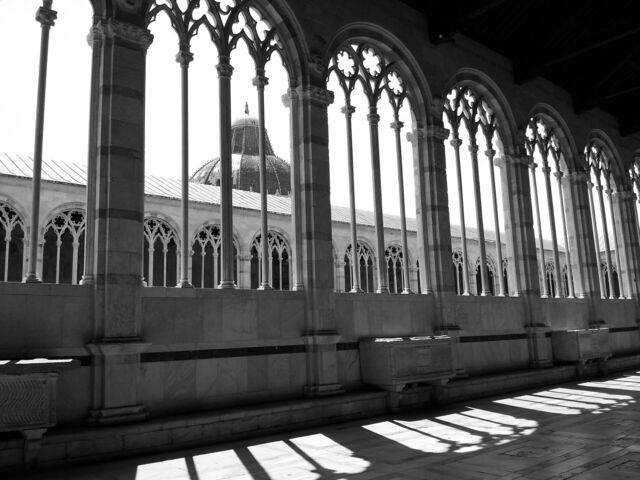
Upon arriving in Pisa, you might be momentarily blinded by the iconic Leaning Tower and the many photo opportunities it provides. If you look a little further, you might venture towards the church next door, lured by the sound of beautiful singing. If you look yet a little closer still, you'll see the Camposanto (literally meaning “holy field”), or Monumental Cemetery, which is the final resting place of important and famous individuals and wonderfully combines stunning architecture and beautiful frescoes.
Constructed in 1278, using sacred dirt brought back from Golgotha during the Crusade, it was later decorated with extensive frescoes and was the burial place of the Pisan upper classes for centuries. For those who have found a holiday rental in Pisa, it might not be the most obvious tourist attraction but it is well worth a visit.
Constructed in 1278, using sacred dirt brought back from Golgotha during the Crusade, it was later decorated with extensive frescoes and was the burial place of the Pisan upper classes for centuries. For those who have found a holiday rental in Pisa, it might not be the most obvious tourist attraction but it is well worth a visit.
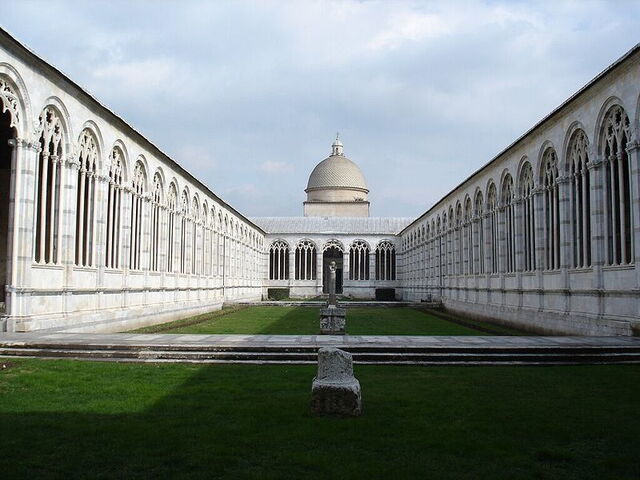
In the 12th century, Archbishop Ubaldo Lanfranchi brought back shiploads of holy dirt from Golgotha, the site of Christ's crucifixion, during the Crusades. In 1278, Giovanni di Simone, the same architect who designed the iconic (if not flawed) Leaning Tower (then just a tower), was called upon to create a structure to enclose this holy earth. He designed a marble cloister and it became the primary cemetery for Pisa's upper class until 1779.
In the 14th and 15th centuries, the walls were embellished with frescoes by Taddeo Gaddi, Spinello Aretino, Benozzo Gozzoli, Andrea Bonaiuti, Antonio Veneziano, and Piero di Puccio. These were almost completely destroyed by a bombing raid during World War II. Thankfully, they have since been fully restored and most of the surviving frescoes, along with preparatory sketches (called sinopie) found underneath, have been moved to the Museo delle Sinopie in Pisa.
In the 14th and 15th centuries, the walls were embellished with frescoes by Taddeo Gaddi, Spinello Aretino, Benozzo Gozzoli, Andrea Bonaiuti, Antonio Veneziano, and Piero di Puccio. These were almost completely destroyed by a bombing raid during World War II. Thankfully, they have since been fully restored and most of the surviving frescoes, along with preparatory sketches (called sinopie) found underneath, have been moved to the Museo delle Sinopie in Pisa.
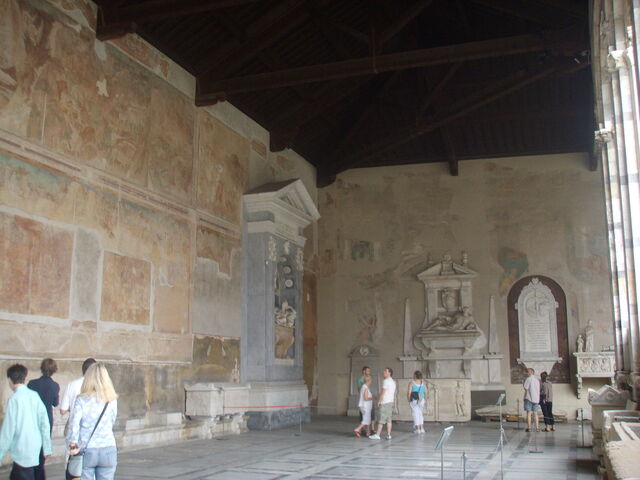
The architecture and frescoes are obvious highlights of the space but the funerary monuments that fill the cloisters are also fascinating artefacts that deserve due attention. 84 sarcophagi, most from the 3rd century AD, have survived despite the bombing of WWII and many reuse ancient Roman sarcophagi.
Roman sculptures were also brought to the Camposanto for decoration from the 14th century onwards and these and the Roman sarcophagi, formed one of the most important collections of Classical art in Europe, which would be used as inspiration for some of Pisa's greatest medieval and early Renaissance sculptures. In addition, there are constant surprises and historical and cultural treasures dotted around the sight that make for an endlessly interesting visit to the site. If you find yourself in this part of Tuscany and at a loss for something else to do, this is a rather unexpected delight.
Roman sculptures were also brought to the Camposanto for decoration from the 14th century onwards and these and the Roman sarcophagi, formed one of the most important collections of Classical art in Europe, which would be used as inspiration for some of Pisa's greatest medieval and early Renaissance sculptures. In addition, there are constant surprises and historical and cultural treasures dotted around the sight that make for an endlessly interesting visit to the site. If you find yourself in this part of Tuscany and at a loss for something else to do, this is a rather unexpected delight.
Photo credits
Picture 2: Kian Wright / CC BY-SA 3.0;
Picture 3: Sailko / CC BY 2.5
Picture 2: Kian Wright / CC BY-SA 3.0;
Picture 3: Sailko / CC BY 2.5